
Wednesday, April 11, 2012
Remi-what?
It's been a while since I truly didn't understand what someone was asking of me in Spanish. I was just at the post office mailing my brother's birthday card when they said, "Lo que sí te voy a pedir es que pongas el remitente." This is what I heard: "I just need to ask you to put the remitente on it." Hmm. Remitente, remitente. Normally new vocabulary words are obvious because of the context. It just wasn't sinking in. I had a blonde moment. Finally, another employee said, "your name and address." AH!!!! Of course. I forgot to put the return address. How silly. I mean what else could he have possibly been asking me to put on the envelope??


Thursday, February 9, 2012
Out of crunchy
A few months ago I was surprised with a pretty awesome gift from the States. A college friend's little sister ventured my way and came bearing peanut butter! Crunchy AND Creamy! Mr. Crunchy now looks like this:

But I will remember him forever because he has been reincarnated as my brown sugar jar.
So, your WOTD is maní: [man-ee]: peanut
I don't want to confuse you, but it has another name in Mexico and Spain: cacahuate
But the first is easier, right? Ok, we'll go with that one. It's the one I can actually pronounce.
So, you might have figured out that we don't have maní butter in Buenos Aires. Ok, that's not true. We don't have Jif and Peter Pan and the like. Nutrition stores started producing the "healthy" maní butter a few years ago, but that's no fun. Plus they like to charge an arm and a leg for it because of simple economics: there's not much demand. So you end up staring at it on the dusty shelf thinking, "Man I'm going to have to stir in all that oil that's sitting on top, it costs half my hourly pay, I'll have to add sugar, AND it will still taste funky with my jelly..." Pass.
It's cool. I've lived without PB for the majority of the last five years, and I'll continue to smile or roll my eyes (depending on my mood) when the newbies ask where they can find Peter Pan. "In Never Never Land" I answered once. I always hope they ask for Peter because I don't yet have any jokes for Jif or Skip.
Argentines don't like maní butter. If they've ever tried it, they don't understand why we like it. BUT, you bring back Reese's Pieces and their faces light up. The trick is not to tell them what's in it. Just let them be.
Oh! And this post couldn't have come at a better time because we are soon moving into the "Peanut Butter and Jelly" apartment. It's on the "PB" floor (planta baja: ground floor) and the apartment is "J." Couldn't dream up a better nickname if I tried. Maybe I'll start my own mini maní butter factory inside to help it live up to its name.
Tuesday, February 7, 2012
I have been ocupada.

Terrible excuse? Yes.
True? Definitely.
What am I talking about? being busy
WOTD: ocupado (masculine)/ocupada (feminine: me): busy
VERY similar to the pronunciation of avocado. Just with "o-coo" at the beginning.
"o-coo-pah-doh"
But we're all ocupado these days, right? Everyone is always saying how ocupado they are, but we still get the stuff we want to do done. Or do we? Because I DO want to write in this blog. I do. I do. I haven't said that so much since I got married.
So I will. I will stop saying how ocupada I am, and I will start doing.
I like 2012 so far. It feels like it's going to be a good year. As long as I'm ocupada with the things I want to be ocupada with, it should stay that way!
p.s. You might have noticed by looking at the photo that ocupado is used for bathrooms when they are occupied! If someone knocks on the door, you say, "Ocupado!"
I remember not knowing what to exclaim when I first moved here. Not that people knock on bathroom doors all the time, but I remember just staying quiet. The silent treatment. Shhhh...she will go away. I think I even said, "Sí!" a few times. "Yes?" Like I was expecting them to ask me a question? Ah...from now on it's "Ocupado!" because I most certainly will be ocupada.
Saturday, August 13, 2011
"Noon to Night"
WOTD: paraguas (par-a-guas): umbrella. Literally: "stop water"
Yesterday morning I was up dark and early with the rain and thunder claps and all.
By the time I left for my first class (8:00) the rain had slowed but was pouring again by the time I got off the bus (8:30). I arrived with a soaked-through rain jacket. Do waterproof rain jackets lose their waterproofing power over time??
Gretel, my student, just laughed. She drives to work and was glad she missed the larger-than-golf-ball-size hail (which came later). By the way, have you ever seen a car elevator? One day she passed me on our way to class so she picked me up and drove into the parking garage and right into a car elevator. I was amazed!! The only one I had ever seen was on the Fisher Price garage! 
My 9:30 student, Juan, had a different way of dealing with the morning's weather. At the downstairs laundromat, he actually walked in drenched, looked at the owner and said, "Give me any pair of dry pants you have. Those. Hanging there." Left his there to be dried, and appeared in the 5th floor offices with pants that belonged to some poor fat man. Do you think the owner of the XL pants will know that Juan had them on half the morning?
Got some errands run before having to be at my MWF job at noon. It was still coming down but the jacket sufficed. I wasn't about to fall for the "15 peso umbrella" trick. "PAR-A-GUA, PAR-A-GUA. PAR-A-GUA, PAR-A-GUA." You walk 5 blocks and it miraculously breaks. You can just imagine the factory conversation in China: "Make me an umbrella that breaks in 10 minutes."
Errands included: visiting the cool new Movistar (cell service provider) building with a pay-as-you-go scratch-off card whose numbers had just disintegrated before my eyes after purchase. Service was surprisingly quick. Yes, I could have a phone plan if I wanted but I actually spend less per month with the scratch-offs than the lowest plan cost. So there's that explanation.
Take the bus. Go 10 blocks. Bus stops dead still about 15 blocks from where I need to be. Of course, rain+public transport in BA=no go. I get off, sprint down Florida Avenue off to pick up my new debit card. First bank account in Argentina. Exciting. Service = again quick. What is UP with you today, BsAs? Oh, I forgot. NO ONE GOES OUTSIDE IN THE RAIN!" Yes, of course, what was I thinking? Note to self: run more errands in the rain.
But before leaving I had to activate the card. Girl who helped me must have thought I was an idiot. "Choose your PIN." Turns away. (ok, done.) "Choose your BBVA Francés PIN." Turns away. (really, they have to be different?? ok, done.) "It can't include any personal information." Turns away. (Wow, they know my phone number. Ok, another.) "It can't have any numbers in a row that coincide with your debit PIN." Turns away. (geez this is getting ridiculous. Ok, another one.) "ok, good. Now when you access online banking you can change your PIN." (There can't possibly be any more series of 4 numbers I would be able to remember.)
I notice fog around the very short skyscrapers downtown. I get to work. And dun dun dun. 15 minutes later this appears out the window:

Along with the previously-mentioned hail. It was all over in minutes. Sky went back to grey from black, and today we're back to sunny. Just another 24 hs. in Buenos Aires.
It made news in English!:
Thursday, May 27, 2010
What I Do
Have you ever thought about the way we ask people what their profession is? What allows them to eat and put clothes on their back? 4 simple words - What do you do? You know exactly what they mean when they say it. They're not asking you if you take showers or baths, if you grocery shop twice a week or once a month, if you spend your weekends playing or watching sports. Do you remember when people used to add (for a living?) at the end of the question? But that has been phased out. Because this definition of DO is society's most important. No specification is required.
Your WOTD is:trabajo [trah-bah’ho] : job, work Listen
And you can also relate to the verb:
trabajar [trah-bah-har'] : to work Listen
I do many things. But as a trabajo, I teach English - specifically to Spanish-speaking Argentines in international companies and private classes. There are a few other freelance trabajos I have been able to add to the list, but teaching is my day-to-day trabajo. Teaching EFL (English as a Foreign Language) is not for everyone. It's the same as someone saying that teaching, in general, is not for everyone. For many years in my young(er) life, I wanted to be a 3rd grade teacher. Mrs. Burr, her 247 stuffed bears, and her compliments (with stickers!) on my creative writing had really gone to my head. Later, when I realized I despised babysitting, I had a change of heart. When I discovered the idea of traveling to another country to teach adults, I was thrilled.
Saturday, September 12, 2009
Screaming USofA in Flip-Flops
I’ll start by saying that I have nothing against flip-flops. Sincerely. They make a comfy, incredibly economical concept for our feet. I remember back in high school and college when flip-flops identified a person. This is when designers and marketers got smart and somehow succeeded (and still do) in selling a $50 contraption of rubber and toe floss to a certain niche. First there was Reef, and then there was Rainbow, and then the 20 different colors from Old Navy for $3 a pair which some only donned post-pedicure. Now I have no idea what’s going on in the flip-flop scene of the United States, but I do know that they have continued to remain popular among university study abroad students at least. Of course, South Americans are not unaware of flip-flops. And yes, they even have their own word (actually, two) which will be your W(s)OTD:
chancleta [chan-clay’-tah]: flip-flop
ojota [o-ho’-tah]: flip-flop
The thing is…chancletas here are not considered acceptable for everyday wear around the city. I learned this the hard way during my second week in Buenos Aires. At the end of my first date with an Argentine, it started to rain. And then pour. It was summer, and I had put on a skimpy pair of ojotas without thinking twice. We dashed across the street to get to my bus stop (jay“dashing”, of course). I stepped up on the curb, and BAM. I was on my bottom in a puddle. I could have blamed it on clumsiness, but it was more likely a mix of that and my no-traction chancletas. The Argentine didn’t really know how to react. He had most likely never seen a woman fall on her butt due to her own lack of grace and the inability to choose appropriate footwear. (I have yet to see an Argentine woman under the age of 70 fall on the sidewalk.) Nevertheless, he gave me his arm and then never called again.
It bothers me in the least if foreigners want to stick out like sore thumbs before their lips even part. And when I see two guys walking down the avenue in shorts and ojotas in 60° weather, I can practically sniff the United States spirit (and their feet, of course).
Wednesday, June 24, 2009
Jaywalking

In elementary school, Mrs. Jackson provided each of us with dictionaries one day. She told us to close our eyes and gingerly thumb through the pages, stopping on whichever page we chose. My finger landed among the thin pages of J. Next, we were told to look at the words on our page and pick one that we had never seen. I picked jaywalk and wrote it up on the chalkboard. After reading the definition to the class and contemplating the extra explanation from Mrs. J., I remember thinking it was an unnecessary word in my life. I hardly ever crossed streets in busy intersections because I was from Waco…in reality, the suburbs of Waco, and any moderately busy street intersection was always crossed in the comfort of a station wagon or my mother’s big-as-a-boat Cadillac.
To my knowledge, there is not one simple Spanish word for jaywalk, so we must settle with this WOTD:
cruzar [croo-thar’] : to cross (verb)
To my knowledge, there is not one simple Spanish word for jaywalk, so we must settle with this WOTD:
cruzar [croo-thar’] : to cross (verb)
cruzar mal [croo-thar’ mahl]: cross poorly/bad/wrong (in other words: jaywalk)
Fast forward 18 years or so, and cruzar mal is now part of my daily life. I feel anxious standing on the sidewalk corner. Why would I wait for the red standing man to change to the white walking man when I can just cross now? No cars will come close to me for at least 5 seconds. And there I find myself…across the street. I just crucé mal. Many times I do not wait for the street corner. I take those short, quick glances over my shoulder as I step into the street halfway down the block as if I’m Alberto Contador checking out Lance Armstrong in the 2009 Tour de France to make sure I still have the lead. But one of the biggest threats of cruzar mal isn’t the cars. It’s the little motorcycles and mopeds that the 50,000 BsAs delivery and courier boys use that could potentially give you a whopper of a bruise. In the busy streets of what is the downtown business district of Buenos Aires, it’s not uncommon to see them run someone over every once in a while.
I only think twice about cruzar mal if it’s obvious that I won’t make it to the opposite curb without losing a limb, or…if I’m standing next to or on the corner across from a woman with children who is glaring at me suspecting that I’m a person who cruza mal and will set yet another bad example for her poor Marcelo/a who just 35 seconds before walked by a newspaper stand with nudie magazines plastered everywhere and inquired, “Mamá, Why doesn’t your bottom look like that?”
Ah, the thrilling monotonies of daily life in the big city…
Saturday, April 18, 2009
Torta de Zanahoria
Your WsOTD:
torta [tor’-tah]: cake Listen
zanahoria [zahn-nah-o’-ree-ah]: carrot Listen
Yesterday, for the first time in over two years, it was my chance to teach my adopted Argentine grandmother a thing or two about baking. Or maybe just a thing. The recipe. She’s got the baking part down to her own science to the point that she adamantly expressed three times how no one knows her oven better than she. True, and that is more of an art here considering that the majority of ovens have no friendly knob with etched centigrade markings. But even those numbers could cause confusion for the
So, together with my oven expert, we carefully mixed together first the “wet” and then the “dry” ingredients in order to make a cake that the common Argentine has never heard of nor tasted: torta de zanahoria (carrot cake). Coaxing an Argentine to try a new recipe is a topic unto itself. They are simple eaters and the vast majority do not delight in trying the newest fusion at the newest restaurant even if they have the money to spare.

While she updated me on her children and her true, non-adopted grandchildren, I finished off the coffee she had percolated earlier that morning and waited patiently to see if the finished torta would please her as much as it had me. Timers are often thought to be an unnecessary kitchen ornament with the sense of smell serving as a useful replacement. And to the trained nostril, this almost never fails. The aromas of cinnamon, zanahoria, brown sugar, and orange (the secret to this recipe) began to seep out from the trusted oven, the door was hatched, and our torta was ready. I copied the recipe into Spanish for my “grandmother” and even taught her the adjective yummy in English. She put her new word to good use because mmmm, it was yummy.
Saturday, March 7, 2009
When Whistling Works

I thought the burnt kettle might actually stick around and cool off for a little while, but she got thrown out into the street along with the rest of Friday's useless garbage. Poor little thing...I wanted a picture to commemorate her months of service. She was white with little flowers. As a result of her tragic destiny, she ended up grayish black with melting petals. Oddly enough, I believe someone might have premeditated our feminine teapot's untimely death. About a week ago a big, blue, masculine teapot showed up in the apartment. Come to think of it, I didn't ask why or from where. He just appeared, sat patiently next to the stove letting the lady do her job for a week or so, perhaps taking pointers, and then took over as the protagonist teapot as of this morning. Because he's a male teapot he's bigger and holds more water which never impressed me because I only need enough for one cup of coffee. But he does whistle...something extremely characteristic of all males here in Buenos Aires. This whistle, for once, is appreciated.
Your WOTD:
silbar [sil-bar']: to whistle Listen
Wednesday, February 18, 2009

Wednesday, February 4, 2009
Gashes in your Lashes
It's quite possible that you've never noticed missing patches of hair on someone where it should be. I’m not talking about receding hair lines or overestimated waxing. The Mayo Clinic describes Trichotillomania (trik-o-til-o-MAY-ne-uh) as an irresistible urge to pull out hair from your scalp, eyebrows, eyelashes or other areas of your body. It is thought that around 1% of the U.S. population experiences the disorder.
Of all the possible places from which to pluck your natural layer, one area in particular might invite the most attention. Your WOTD:
ceja [say-hah] : eyebrow Listen
Of all the possible places from which to pluck your natural layer, one area in particular might invite the most attention. Your WOTD:
ceja [say-hah] : eyebrow Listen

What causes this strange compulsive disorder? The most trying for individuals who suffer the symptoms is the fact that those who have never experienced a similar peculiar comfort cannot come close to relating. Who on earth would want to knowingly damage his natural symmetry? Some loved ones go so far as to put tape across the cejas of their poor picking person. An unfortunate individual with this habit will often lie nonchalantly when asked. “Oh, my waxing lady messed up.” Yeah right. Or, “Oh, I accidentally shaved that part off with a razor.” That’s about as believable as a stammering 16 year old swearing that the plum-colored hickey is a curling iron burn. Come to think of it, even that’s hard to say these days as I have this notion that curling irons are not quite used by masses of women as they were 10 to 15 years ago.
Discovering this particular type of compulsive behavior makes me wonder how many of us suffer from concealed self-destructive actions. It seems as though something’s not right. Is it possible this particular disorder, even if not identified, existed a century ago? What about eating disorders, self-mutilation, etc? I’m not so sure we can blame all this on global warming.
Monday, February 2, 2009
Gauchito Gil
"How 'bout them cowboys?" Not the Dallas Cowboys (not that they resemble anything close to the real thing) or the wild west cowboy, but the:

gaucho [gow-choh] : herdsman, or cowboy of the South American pampas Listen
As in Texas, this special character is not as easily found in Argentina as in the 19th century, but their historical reputation keeps them alive and breathing. Picture a Texan cowboy, now take away the 10 gallon Stetson, replace it with a lower, broad-brimmed black hat, tuck a knife in the leather belt at the back and you’re on the right track. In case your imagination is betraying you:

Gauchito Gil (the diminutive form of gaucho used in a loving way) was an unruly Argentine gaucho in the late 1800s. In his Robin Hood adventures he served the poor by spreading the riches of the wealth. After refusing to fight his fellow brothers in one of the country's civil conflicts, he was held at knife point by a police sergeant who paid no heed to Gil's proclamation that he could cure the officer’s ailing child. With a flick of the wrist, Gauchito Gil was left dead, but the officer prayed nonetheless and the child was indeed healed. Ever since then, Gauchito Gil has been the channeled recipient of many prayers and requests from those just knowing that he can work another miracle.
On a late spring day not oh so long ago, I found myself on a road trip through the Argentine countryside. Every now and then along the two lane highway, we passed a little red, wooden, doghouse-looking structure propped against a lonely tree trunk. Red flags and banners waved outside the entrance of the little house; some big, some small. As we passed this curious scene, the driver would yell, “I’ll Cheeto here!” I wondered if the little red doghouses held sacred bags of cheesy Cheetos puffs, but that didn’t seem quite right. After the fifth “I’ll Cheeto here!” I had to ask.
“What on earth are you saying?”
“It’s Gauchito Gil! Don’t you know Gauchito Gil?”
No, at that time I didn’t. And when I asked the driver to slow down as we approached the next eye-catching banners, I saw that there was in fact a little gaucho standing inside his private shrine. He was surrounded by everything from flowers to used car parts – offerings and personal tokens from the road. There were no Cheetos in sight; perhaps that could be my contribution the next time around – a little inside joke between GG and me.
Monday, January 26, 2009
Go Go Grease Lightning
I received a random text message today from a student asking me, "How do you say 'grasa'?" If he had wanted the simple translation, it would have been the following definition of today's WOTD:
grasa [grah-sah] : grease, fat, lard (found in the kitchen) Listen
grasa [grah-sah] : grease, fat, lard (found in the kitchen) Listen
His question held my attention since I had been asked the same question by two other Argentine women while preparing dinner in the kitchen on Saturday night. Fortunately, I follow conversations well enough in Castellano to know that they were not talking about the grease. Nor the fat, nor the lard. Had the conversation taken place two years ago, I would have automatically assumed they were referring to the white stuff forming on the pile of meat leftover from lunch. But no. They wanted to know how we translate this word that in Argentina, and only in Argentina I believe, is used to describe:
-the hairy-chested man with 4 buttons left open and a gold chain dangling around his sweaty neck
-the woman with extremely overdone silicone bosoms
-the kid who flashes you a vulgar gesture in the road just because
Today, my answer to the text message was "tacky, sleazy, trashy." I've never found ONE single word to describe this idea that can be used in so many ways here. It's still one of those words I use with doubt unless I'm asking where the jar of grasa is in the kitchen.
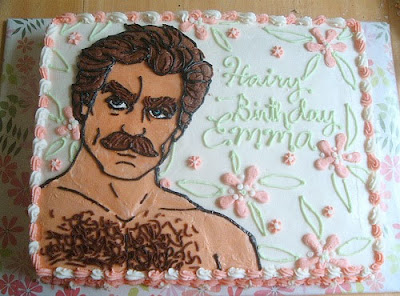
A grasa birthday cake?
Thursday, December 4, 2008
Lunching on Ice Cream
Your WOTD:
helado [ay-lah’-do] : ice cream Listen
 A different view at night:

helado [ay-lah’-do] : ice cream Listen
I have a love-hate relationship with the helado in BsAs. It's some of the best I've tasted outside of Italy, although I don't think I'll ever put a winning blue ribbon on any other than my classic Blue Bell Cookies 'n Cream. So why the hate? Such a strong word, but it fits nicely with the 200% increase in helado parlor prices in the last 2 years. Today was a beautiful day. 25°C (78°F), sunny, little wind...I have 3 classes in a row at Prudential downtown and my 1:00 class decided they wanted to go get ice cream with the 12:00 class students who announced they were going to Freddo. (an helado chain) So we all went together. They said we would speak in English to make up for the lost class, but that never happens. We all spoke in Castellano.
Downtown is a stone's throw away from an area called Puerto Madero; this is the newest addition to BsAs. They revamped the old port area along with the warehouse buildings and it is now home to the big international companies and some of the most expensive restaurants in town.
Ice cream for lunch:
Strolling during the day:
A different view at night:
Wednesday, November 19, 2008
What I Do.
Have you ever thought about the way we ask people what their profession is? What allows them to eat and put clothes on their back? 4 simple words - What do you do? You know exactly what they mean when they say it. They're not asking you if you take showers or baths, if you grocery shop twice a week or once a month, if you spend your weekends playing or watching sports. Do you remember when people used to add (for a living?) at the end of the question? But that has been phased out. Because this definition of DO is society's most important. No specification is required.
Your WOTD is:
trabajo [trah-bah’ho] : job, work Listen
And you can also relate to the verb:
trabajar [trah-bah-har'] : to work Listen
I do many things. But as a trabajo, I teach English. Specifically to Castellano-speaking Argentines in international companies and private classes. There are a few other freelance trabajos I have been able to add to the list, but teaching is my day-to-day trabajo.
Teaching EFL (English as a Foreign Language) is not for everyone. It's the same as someone saying that teaching, in general, is not for everyone. For many years in my young(er) life, I wanted to be a 3rd grade teacher. Mrs. Burr, her 247 stuffed bears, and her compliments (with stickers!) on my creative writing had really gone to my head. Later, when I realized I despised babysitting, I had a change of heart. When I discovered the idea of traveling to another country to teach adults, I was thrilled.
http://www.baexpats.org/ is a forum for expats living here, some who used to live here, those who are daring to move here, and anyone else interested in the ins and outs of daily life in Buenos Aires for an expat. You can find everything from questions about where to find peanut butter and maple syrup (latter impossible) to the detailed explanation of the 37-step process to receive a residency permit (that is, after you qualify).
Recently, a fellow expat vented his consternation at not being able to find a job teaching English. Most responses were helpful, but the one that made me "type" up is the following:
"Stanexpat" I am sympathetic to any person having trouble finding work, but in this case I would have to say I am in agreement with steveinBsas. I assume most of the people trying this are young early to mid 20's. What on earth are they doing in Argentina? Shouldn't these people be a home getting a real job and starting their adult lives? Isn't a lot of this just people trying to extend their adolescense years. Maybe I'm old fashioned but I believe other people see this the same way.
He was hit with a lot of arguments and, I'm sure, cold shoulders. The thing is, any one trabajo has many different levels of dedication, and in TEFL the level fluctuates wildly. This guy is focusing on one end of the spectrum while I strive trabajar at the other. I'll leave you with this comment in response to his opinion:
What on earth are they doing? Heaven forbid that they are getting to know another part of the world and trying to make a peso while doing it. Shouldn't they be waiting in line back home to become a part of the rat race, you ask? Yeah, sounds thrilling. Jumping right on the bandwagon.
I also think many come to learn and/or improve their Spanish in hopes of using it in their future "real job." Some of them don't achieve that since they end up spending all their time with other English-speaking expats, but there are many exceptions. And there's no way they leave without learning something...even if that is "Sí, una copa de vino tinto por favor."
Mind you that it is possible to make a "real job" out of this ridiculous English teaching gig. One can take it as seriously or as light-heartedly as one likes. What is a "real job" anyway? A 9 to 6? With benefits? A 30 minute lunch break? A cubicle? Deadlines? Maybe even a corporate car someday?
"Real" or not, a job that pays the bills, leaves some money left over for life's simple pleasures, and allows that I do not leave my house with a "cara de culo" on Monday morning is a job for me.

Your WOTD is:
trabajo [trah-bah’ho] : job, work Listen
And you can also relate to the verb:
trabajar [trah-bah-har'] : to work Listen
I do many things. But as a trabajo, I teach English. Specifically to Castellano-speaking Argentines in international companies and private classes. There are a few other freelance trabajos I have been able to add to the list, but teaching is my day-to-day trabajo.
Teaching EFL (English as a Foreign Language) is not for everyone. It's the same as someone saying that teaching, in general, is not for everyone. For many years in my young(er) life, I wanted to be a 3rd grade teacher. Mrs. Burr, her 247 stuffed bears, and her compliments (with stickers!) on my creative writing had really gone to my head. Later, when I realized I despised babysitting, I had a change of heart. When I discovered the idea of traveling to another country to teach adults, I was thrilled.
http://www.baexpats.org/ is a forum for expats living here, some who used to live here, those who are daring to move here, and anyone else interested in the ins and outs of daily life in Buenos Aires for an expat. You can find everything from questions about where to find peanut butter and maple syrup (latter impossible) to the detailed explanation of the 37-step process to receive a residency permit (that is, after you qualify).
Recently, a fellow expat vented his consternation at not being able to find a job teaching English. Most responses were helpful, but the one that made me "type" up is the following:
"Stanexpat" I am sympathetic to any person having trouble finding work, but in this case I would have to say I am in agreement with steveinBsas. I assume most of the people trying this are young early to mid 20's. What on earth are they doing in Argentina? Shouldn't these people be a home getting a real job and starting their adult lives? Isn't a lot of this just people trying to extend their adolescense years. Maybe I'm old fashioned but I believe other people see this the same way.
He was hit with a lot of arguments and, I'm sure, cold shoulders. The thing is, any one trabajo has many different levels of dedication, and in TEFL the level fluctuates wildly. This guy is focusing on one end of the spectrum while I strive trabajar at the other. I'll leave you with this comment in response to his opinion:
What on earth are they doing? Heaven forbid that they are getting to know another part of the world and trying to make a peso while doing it. Shouldn't they be waiting in line back home to become a part of the rat race, you ask? Yeah, sounds thrilling. Jumping right on the bandwagon.
I also think many come to learn and/or improve their Spanish in hopes of using it in their future "real job." Some of them don't achieve that since they end up spending all their time with other English-speaking expats, but there are many exceptions. And there's no way they leave without learning something...even if that is "Sí, una copa de vino tinto por favor."
Mind you that it is possible to make a "real job" out of this ridiculous English teaching gig. One can take it as seriously or as light-heartedly as one likes. What is a "real job" anyway? A 9 to 6? With benefits? A 30 minute lunch break? A cubicle? Deadlines? Maybe even a corporate car someday?
"Real" or not, a job that pays the bills, leaves some money left over for life's simple pleasures, and allows that I do not leave my house with a "cara de culo" on Monday morning is a job for me.
Thursday, November 13, 2008

Saturday, November 8, 2008
Monedas! Monedas! Where are all the monedas?
Ok, so I've written about this before. But not on my blog. And not with the nifty audio file. Your WOTD is:
moneda [mo-nay'-dah] : coin Listen
There are many circumstances where your WOTD might have another or multiple meanings, but to keep things simple and to the point, we will stick to the translation which focuses on the topic.

 "Usá tus monedas. No las guardes."
moneda [mo-nay'-dah] : coin Listen
There are many circumstances where your WOTD might have another or multiple meanings, but to keep things simple and to the point, we will stick to the translation which focuses on the topic.
So, I was one step ahead today. The camera actually made it into the backpack. But by the time I could get to it to take a picture of the couple digging for monedas in their pockets, bags, and ears on the bus today, they had succeeded in their quest, had inserted the desired monedas into the moneda machine, and took the front seats up by the driver. Boy, were they lucky. They were Spanish speaking tourists. I know this because A. they were speaking Spanish - (or Castilian) and B. because they did not know that they couldn't get change on the bus. I smiled as I heard the driver flatly answer, "Sí, monedas únicamente" (Yes, coins only.) two or three times as their bewildered faces asked that question. Really? We can only pay with monedas?
Ok, so what's the big deal, you ask? Well...if there were monedas growing on trees, it wouldn't be a big deal. But that's not the case. Remember the fruit vendor who didn't have change one day so he gave me a tangerine instead of my 10 cent moneda? You'll go to the grocery store. You'll lie. No, I don't have monedas. Liar, liar pants on fire. But no lie = no bus ticket, so it's survival of the fittest...or, really, the most mendacious. Sometimes it backfires on you. You want an alfajor (special Argentine cookie) that costs 50 cents. You only have a 2 peso bill. They ask for monedas, you lie, and they won't sell you the alfajor. If you had 50 cents all along, you can't just pretend like the coin magically appeared next to your foot on the sidewalk so you walk to the next little kiosk and think twice, but use your 50 cent moneda for that alfajor you wanted so badly. There is actually a moneda exchange office where people can change up to 50 pesos ($15 US) a week in monedas. I've never been, but I've seen them lined up on the news channel with the first guy saying he got there at 5:00 a.m. and was still waiting 3.5 hours later. Ah, Argentina. These are the things that make life just a little more quirky here.
Last night after dinner with two friends, Emily and Andrea, I walked Andrea to her bus stop. Now, that was being a good friend, right? And then I hear, "Oh no! What am I thinking? I don't have monedas." I look at her. I know where this is going. I'm about to sacrifice a moneda. And as the #12 rumbles our way, I open my moneda purse, press the one peso moneda into her hand, and know that my pants are definitely not on fire. "A friend in need is a friend indeed."
 "Usá tus monedas. No las guardes."
"Use your coins. Don't hoard them."
Update! Nov 22, 08. Wouldn't it have been nice to appear in the Times?
Friday, November 7, 2008
Castellano / Globalization Hits my Block
I would like to just start writing on this blog as though that's what I've been doing for my last 21 months in Buenos Aires. Really, there's no real reason that I never started it (the blog) earlier. I credit the title and its idea to my mother who would in turn give credit to someone else. So. For some of you, "Castellano Word of the Day" might make more sense titled "Español Word of the Day" but here in Argentina they refer to their spoken language as Castellano and not Español so this is officially your first WOTD:
Castellano - Castilian (and/or) Spanish. [cas-teil-lyah’-no] or my version [cas-teh-yaw-no]
Listen
Castilian refers to the original language which spread across Spain and which most around the world now refer to as Spanish. Click if super interested.
Mind you, this blog could easily turn into Castellano WOTW or WOTM (Word of the Week or Month). WOTD doesn't necessarily mean daily. I just don't want expectations getting too high.
So why this globalization title? I had one of those "Geez why don't I ever take my camera with me?!" moments today 2 blocks from my apartment. Less than a year ago, articles on Buenos Aires would rave about the historic atmosphere in the quaint cafe culture and how there was no Starbucks in sight as could be found in Madrid, Shanghai, Moscow, and numerous other big cities across the globe. I was never a fan of Starbucks since I prefer my personally-brewed coffee which comes out to about 1/47th of the price (just an estimate). The rumors circulated, and then it was true; the first BsAs Starbucks opened in May. But in a location that was obvious - a posh mall in the middle of a nicer neighborhood and I wasn't surprised. But then a few weeks ago, much to my dismay, I see this on the corner 2 blocks from my front door:
 It's not like I'm that person that said he would never shop at WalMart because it was running all the MomandPops out, but the lack of the huge international coffee chain was something I really treasured about BsAs. My new neighborhood location opened a few days ago, and business has been non-stop. The picture I wanted to take today was of the line of 10 Catholic school boys in uniform walking out the door with their initialed vanilla frappes in hand. I've seen this city change quite a bit since February 07. Good and bad. This is a change I could do without. You can find me in the quiet cafe a few doors down.
Subscribe to:
Posts (Atom)